
This winter, DraftKings has shown such strong momentum that the company released its Q4 2024 financial results ahead of schedule.
A 17% surge in its stock price certainly provides the confidence to do so. Wall Street analysts were pleased with the performance DraftKings delivered. David Katz, an expert at Jefferies Equity Research, wrote: “Strong early-year betting outcomes, combined with market expansion and accelerated growth in in-play betting, point to further upside.” In fact, DraftKings raised its revenue guidance, though its cash flow projections remained unchanged.
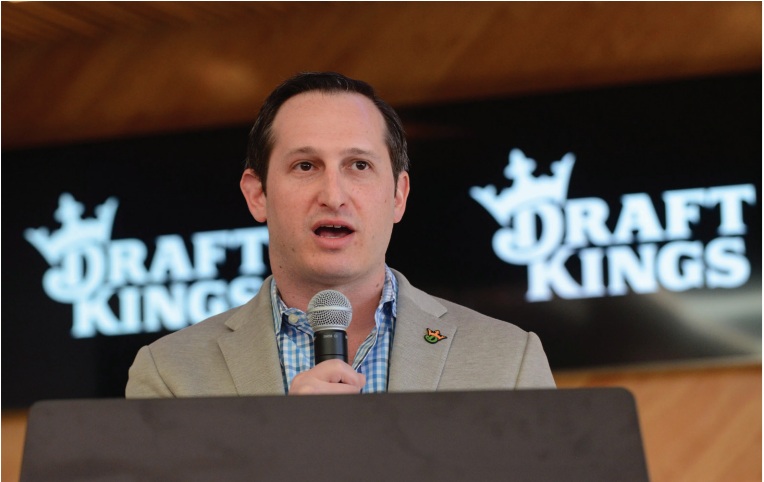
Jason Robins
Image: DraftKings CEO Jason Robins
In the fourth quarter of 2024, DraftKings saw its revenue grow by 13% to $1.4 billion. Its cash flow of $89.5 million significantly outperformed Wall Street expectations. The number of unique players increased by 16%; when including data from the lottery services platform Jackpocket, that growth reaches 36%.
(More on Jackpocket later.) Looking ahead to 2025, DraftKings expects revenue to fall between $6.3 billion and $6.6 billion, with cash flow reaching at least $900 million—potentially even hitting $1 billion—which implies a very high return on investment. (Katz forecasts this figure at $993 million.) These projections may even be conservative, as they do not yet account for Missouri, which has legalized sports betting.
Increasing the “Hold Percentage”
Following the earnings call in mid-February, Katz remained optimistic. He noted that DraftKings aims to increase its “hold percentage”—the portion of total wagers that the sportsbook retains. This is driven by an increase in “proposition bets” and “single-game parlays”—types of wagers that, while offering lower returns to players, have proven to be highly profitable for the company’s primary competitor, FanDuel.
(FanDuel’s hold percentage—the portion of total wagers retained—stands at 14.5%, compared to 11% for DraftKings.) Katz also noted that, despite having ample cash on hand, DraftKings remains “interested in establishing a presence in the debt markets.” Even with $788 million in cash, the company plans to use debt financing to support a recently launched share repurchase program. Barry Jonas, an analyst at Truist Securities, remarked that while U.S. sportsbook operators faced “unfortunate” outcomes during the NFL season, DraftKings “lost some battles but won the quarter.” He specifically highlighted the most recent Super Bowl, which set company records for both single-day betting volume and total gross gaming revenue.
Jonas explained: “Revenue growth was driven by sustained, active user engagement, effective customer acquisition strategies, expansion into new jurisdictions, a higher structural hold percentage, and the acquisition of Jackpocket—all of which helped offset the negative impact of unfavorable NFL game outcomes.” The 2024-2025 NFL season was described as “the most unfavorable season for sportsbook operators in the last 40 years (with 10 weeks seeing favored teams win at a rate exceeding 75%).”
In financial terms, this resulted in a $160 million reduction in DraftKings’ revenue and a $104 million decrease in cash flow. Fortunately, the company has seen a strong start to 2025; according to Jonas, the hold percentage has reached 13%, with “solid performance in customer acquisition, retention, and engagement.” Furthermore, the DraftKings app has topped the charts for downloads in the betting category across major app stores and ranks third in total downloads among all applications.
Total betting handle increased by 21% compared to 2023, with the company adding 3.5 million new customers. In 2024, the number of unique customers grew by 42%, reaching 10.1 million.
A “Mismatch” Creates Opportunity
For DraftKings, one of the most effective customer-acquisition events outside of American football wasn’t even a traditional “sporting event”—it was the lopsided showdown between Jake Paul and an aging Mike Tyson. (Unsurprisingly, Tyson lost.) The event even bolstered DraftKings’ confidence, prompting the company to consider expanding its footprint beyond North America.
However, DraftKings executives encountered an unexpected challenge in Missouri. The state’s new Secretary of State, Denny Hoskins, has employed various “innovative” tactics to repeatedly delay the launch of legal sports betting. Hoskins has long sought to tie the legalization of sports betting to the legalization of “black market” slot machines, raising questions about his true motives. For DraftKings, an early launch in Missouri—ideally in 2025—would significantly boost profitability.
Meanwhile, the impact of a sharp tax hike in Illinois has been somewhat mitigated. DraftKings has scaled back its marketing efforts in the state and reined in promotional spending. CEO Jason Robins downplayed the significance of the Illinois tax increase, framing it as an isolated case while expressing optimism regarding the stability of tax policies in other jurisdictions. Despite Robbins’ optimistic outlook, Maryland, New Jersey, and Ohio are currently considering raising tax rates on sports betting (as well as certain forms of online gambling/iGaming). Furthermore, a coalition of brick-and-mortar casino operators has formed in an effort to curb the expansion of online gambling.
Playing with fire?
Meanwhile, Robbins is exploring the possibility of allowing users to place bets using highly volatile cryptocurrencies. Like FanDuel, DraftKings is currently awaiting the outcome of litigation concerning the legal status of “prediction markets.” FanDuel previously attempted to accept wagers related to the Super Bowl and now intends to further expand such offerings.
This is a major point of contention for traditional gambling operators, as “prediction markets” effectively function as a nationwide, unlicensed, and unregulated form of sports betting. Nevada is currently taking a hardline stance against them, and other jurisdictions may soon follow suit.


Comments