
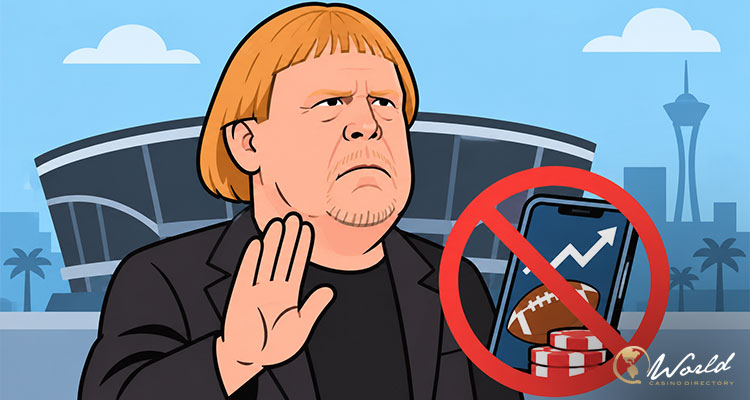
Mark Davis, owner of the Las Vegas Raiders, has expressed skepticism and concern regarding the growing influence of sports betting in professional sports. He is particularly worried about the risks posed by “proposition wagers”—bets placed on specific events or details within a game—and the potential for gambling to undermine public confidence in the integrity, or authenticity, of the games themselves.
In an interview with CNBC, Davis noted that while sports betting can generate significant commercial revenue for professional leagues and team owners, he remains uneasy about certain forms of wagering. As betting markets continue to gain traction in the United States, the NFL faces mounting questions about how these platforms should be regulated.
“Personally, I’m not a fan of sports betting—especially ‘prop bets’ on specific events or details,” Davis said.
The Raiders owner believes that the “integrity” of sporting events is the core issue, emphasizing that fans must have faith in the authenticity of the game’s outcome. He also questioned whether the financial gains from betting partnerships are truly worth the potential negative consequences for professional sports.
“People have to believe in the game,” Davis said. “Is it worth the risk? I don’t know. I can’t answer that.”
Davis questions the risks brought on by the expansion of sports betting.
Davis’s stance is particularly notable given that his team, the Raiders, relocated from Oakland to Las Vegas in 2020—a move that brought the NFL into the heart of America’s gambling capital. Furthermore, he also owns the Las Vegas Aces of the WNBA.
Despite his deep ties to the city, Davis recalls a time when the NFL maintained a strictly anti-gambling stance. He remembers that, in his youth, the league viewed any involvement in betting as a serious disciplinary offense, with players receiving stern warnings against it. He recalled: “I remember growing up, there was a large sign hanging by the door leading from the locker room to the outside world. It read: ‘Gambling of any kind is strictly prohibited’—with the penalty being suspension or even expulsion from the league.”
Davis also raised questions regarding the regulation of the gambling industry as it expands across the United States. He noted that before the Raiders relocated to Nevada, the team conducted a study which concluded that Las Vegas had robust safeguards in place to mitigate integrity risks associated with gambling.
“When we decided to move to Las Vegas, we conducted a study,” Davis explained. “It indicated that Las Vegas might actually be the ‘safest’ place in the country for gambling, precisely because it is subject to such rigorous regulation.”
However, he pointed out that the growing popularity of sports betting presents new challenges for professional sports leagues, which must now ensure effective oversight and guarantee that athletes adhere to the rules.
These remarks come against a backdrop of frequent gambling-related controversies in North American sports, including investigations into athletes placing prohibited bets and allegations of match-fixing. Such incidents have prompted increased scrutiny of the relationship between gambling operators and professional sports.
NFL Takes a Cautious Stance on “Prediction Markets”
The rise of “prediction markets”—platforms where users trade contracts linked to the outcomes of sporting events—has added a new layer to this issue. This has sparked debate over how these platforms should be classified for regulatory purposes, and to what extent sports leagues should engage with their operators.
Compared to some other professional sports leagues, the NFL (National Football League) has adopted a more cautious approach toward “prediction markets.” While the NFL has entered into commercial partnerships with traditional sportsbooks, it has so far declined to reach any formal agreements with operators of prediction markets. In September, NFL Commissioner Roger Goodell clarified the league’s position, emphasizing that more robust regulatory mechanisms must be established before any further expansion into this space is considered.
Subsequently, in October, the NFL filed an amicus curiae brief with the Supreme Court, arguing that “prediction markets” should be classified as gambling and placed under the regulatory jurisdiction of individual states.
The NFL has previously expressed concerns regarding the link between gambling activities and the outcomes of sporting events. Even as the league has embraced the commercial opportunities presented by legalized sports betting, Goodell has warned that the deep penetration of gambling could cast doubt on the integrity of routine occurrences during a game.
His point at the time was that standard errors or controversial officiating calls could fuel speculation about “match-fixing”—especially when spectators have a financial stake in specific game events or outcomes.
Commercial partnerships add complexity to the issue of “game integrity.”
The owner of the Las Vegas Raiders has acknowledged that gambling has become a significant revenue stream for professional sports organizations. However, he maintains that while major leagues weigh the economic gains, they must also consider the potential risk of reputational damage.
“The scale of revenue generated by gambling and related entities is immense; therefore, a balance must be struck between upholding the integrity of the game and the positive benefits that gambling can bring to the league.”


Comments