
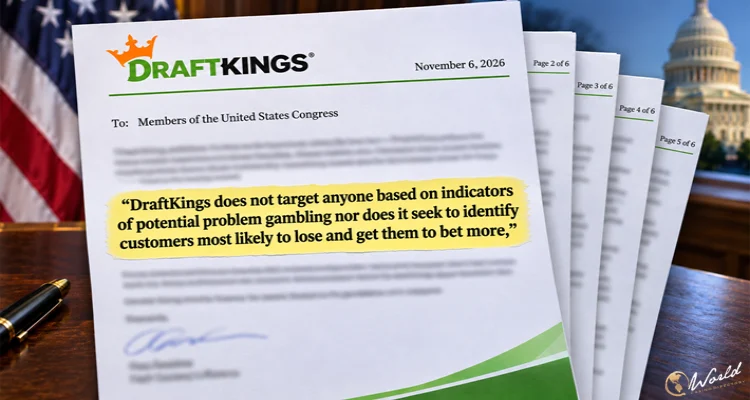
DraftKings has informed members of Congress that its VIP and rewards programs are not designed to target customers who show signs of gambling problems, nor are they intended to identify bettors most prone to losing money in order to induce them to place more wagers.
The company outlined this position in a six-page response to an inquiry submitted on October 22 by Senator Richard Blumenthal and Representatives Paul Tonko and Valerie Foushee. The lawmakers had requested detailed information regarding DraftKings’ VIP operational model and its “responsible gaming” measures.
“DraftKings does not target any customer based on signs of potential gambling problems, nor does it seek to identify customers most prone to losing money in order to encourage them to increase their wagering,” the company wrote.
The response also details how VIP hosts interact with customers and how DraftKings utilizes technology when selecting recipients for promotional offers.
VIP hosts are subject to “responsible gaming” requirements.
DraftKings stated that customers on “self-exclusion” or “involuntary exclusion” lists do not receive any promotional communications. Such communications are also suspended during “cooling-off periods” and for a set duration after a customer returns from such a period.
If a VIP host identifies signs that a customer may be experiencing gambling-related issues, they are required to refer the individual to the company’s “Responsible Engagement Team,” with cases involving crises prioritized for immediate attention.
Furthermore, VIP hosts are required to conduct “responsible gaming” assessments for 10 randomly selected customers each month. These assessments include inquiries into whether the customer is wagering within their personal financial means, whether their betting behavior has impacted other aspects of their life, and whether they continue to view gambling as a form of entertainment. Failure to complete these assessments may affect a host’s compensation. Less than 1% of DraftKings’ customer base falls into the “Diamond” and “Onyx” loyalty tiers; members at these levels receive dedicated account managers and personalized reward programs.
The company noted that decisions regarding these promotional activities are made by humans, rather than through automated systems.
DraftKings also addressed the use of “personalized videos.” The company stated that it “does not use personalized video content from professional athletes or well-known public figures as an incentive,” adding that it is aware of only one instance where a video created via the platform Cameo was sent to a customer.
DraftKings denies using artificial intelligence (AI) for targeted outreach.
The company denies using AI to identify customers who show signs of gambling problems or those who are prone to losing money. “DraftKings does not use artificial intelligence (AI) to identify customers most likely to lose money and encourage them to increase their wagers, nor does it target specific customers for marketing based on indicators related to potential gambling issues. DraftKings employs data science and machine learning—not generative AI or agentic AI—to tailor promotions based on customer preferences, which is a standard marketing practice.”
This follows an investigative report published by The New York Times in September, which drew significant attention. Based on internal documents and interviews with former employees, the report alleged that DraftKings used machine learning models to identify customers who, upon receiving promotional offers, were more likely to increase their wagers and, consequently, incur greater losses.
DraftKings has refuted this claim, asserting that the company does not use AI to target customers based on their losses or signs of potential gambling problems.
The Massachusetts Gaming Commission has also inquired with licensed operators regarding their use of artificial intelligence.
DraftKings declined to disclose data on the average wins and losses of members in its rewards program, citing such information as “competitively sensitive” trade secrets. In response, the company pointed to its “My Stat Sheet” feature, a tool that allows customers to view their deposits, total wagers, and overall profit or loss. Since its launch in March 2024, nearly half of all DraftKings customers have used the tool.
According to a report by InGame, the company also clarified the role of its “VIP hosts”:
“The primary objective of DraftKings VIP hosts is to create a more engaging experience, thereby increasing long-term customer retention and ensuring that customers choose DraftKings over competitors. DraftKings does train its VIP hosts to build and maintain strong service relationships with the most active customers, with the goal of delivering a world-class user experience.”
Continued Pressure from Congress
This inquiry is part of a broader push by some lawmakers to strengthen federal oversight of sports betting.
Blumenthal and Tonko are proponents of the “SAFE Bet Act”—a proposal aimed at establishing federal standards for sports betting, which was reintroduced in the current session of Congress in 2025. The proposal includes provisions to limit betting advertisements during live sports broadcasts, mandate financial capacity assessments, and require states to obtain federal approval before authorizing legal sports betting operations.
To date, the proposal has not been enacted into law and continues to face opposition from some within the gambling industry. Since the U.S. Supreme Court struck down the Professional and Amateur Sports Protection Act in 2018, the regulation of sports betting has largely remained in the hands of individual states.
Congress remains focused on this issue; as lawmakers continue to examine topics related to consumer protection and participation in gambling, the House of Representatives has scheduled a hearing for November 11, 2026, titled “The Rise of Sports Betting on College Campuses.” DraftKings’ response focuses on the safeguards integrated into its VIP program, emphasizing that the original intent behind its promotional mechanisms was to…



Comments