
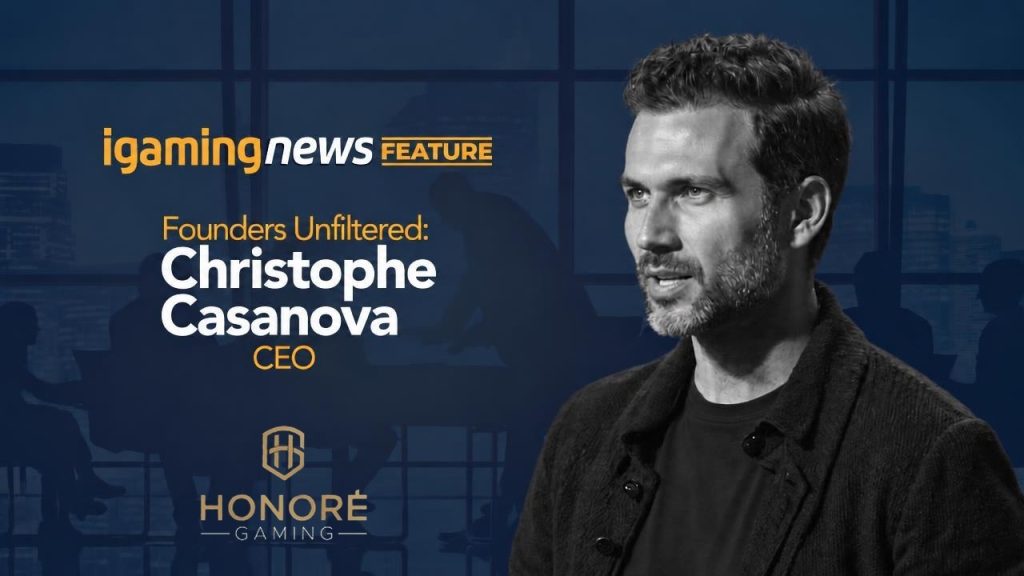
In this edition of Founder Interviews, Christophe Casanova speaks to iGaming News about why patience is the ultimate test for any founder. He discusses how launching a product without a local perspective taught him that innovation must be market-relevant, and explains why his company made the bold decision to build its own platform despite having almost no capital. He also shares his views on mobile payments, the overhyped nature of AI-driven personalization, and the personal toll that founding a company has taken on him.
- What was the initial concept behind your company? What drove you to take the plunge into entrepreneurship?
We were pioneers in the Francophone African market. When we started, there were no ready-made platforms available for these markets—only Western solutions that didn’t fit local realities, or simply nothing at all. No one had made a serious attempt to build a sports betting infrastructure—covering everything from payments and distribution to the retail agent networks that drive the bulk of transaction volume—that was truly tailored to how these markets actually function. As first movers, we had no blueprint to follow; we had to navigate uncharted territory, which presented both risks and opportunities.
- What has been the most difficult part of the entrepreneurial journey—something no one warned you about?
Patience. No one tells you that the hardest part of this business isn’t the technology; it’s the waiting—waiting for licenses, for regulatory clarity, for clients to finally sign on, and for the market to mature enough to justify the capital you’ve invested. Even when you do everything perfectly, it can still take years for all the pieces to fall into place. Patience isn’t usually listed as a core skill for entrepreneurs, yet it is perhaps the trait that is tested the most.
- As a founder, what is the biggest mistake you’ve made, and what lesson did you learn from it?
We failed to view the market through a local lens. Early on, we sometimes tried to showcase “innovation” by launching products we considered cutting-edge—but these products were completely misaligned with how local users actually bet, make payments, or interact with platforms. This taught me that innovation detached from local realities isn’t innovation at all—it’s just a mismatch masquerading as ambition. The real work lies in understanding a product from the market’s perspective before deciding to build it.
- Have you ever seriously doubted whether the company would succeed? What happened?
Yes, absolutely. We initially used an external platform to set our own odds, but we quickly realized it simply didn’t work for Africa; it couldn’t handle the realities of the markets we were operating in. We had to build our own platform, but we had almost no capital at the time. We took a blind leap of faith—it was all or nothing. There were no safety nets; we were betting entirely on ourselves, because failure would have meant the end of the company.
- What is the most important lesson you’ve learned about leadership and building the right team?
Competence is not the same as adaptability, and adaptability is not the same as loyalty. In a company spanning Africa and Central America—covering product, infrastructure, trading, legal, and support—you need people who truly understand that every department must stay within its own scope while trusting the others. Otherwise, you end up with chaos disguised as collaboration. For me, the biggest shift was learning to hire for sound judgment and trusting my team to act within their areas of responsibility, rather than trying to control every single decision.
- What has been the biggest challenge in growing and scaling the business?
We strive for an open-source, lightweight approach, but the reality is that scaling across multiple regulatory jurisdictions and diverse product verticals—sports betting, horse racing, lotteries, virtual games, and instant-win games—adds complexity very quickly. Each new market brings its own unique compliance requirements, payment integrations, and local partnerships. For us, scaling isn’t just about “more customers”; it’s about maintaining architectural rigor as the regulatory and technical landscape continues to expand.
- What misconceptions do you think exist in the iGaming industry regarding entrepreneurship and innovation?
I believe the industry often confuses innovation with feature convergence—chasing the latest buzzwords from the most recent conference instead of considering what a specific market actually needs. Many so-called “innovations” are, in reality, nothing more than a change in the user interface. In my experience, true innovation stems from taking underserved markets seriously and developing solutions tailored to their specific, real-world needs—rather than simply copying Western products and hoping they will somehow fit.
- Which current trends in iGaming do you consider truly transformative, and which are merely overhyped?
What is truly transformative is the emergence of mobile payments as a standalone channel—rather than just an add-on to platforms dominated by bank cards. This is the real key to unlocking these markets. As for what’s overhyped: much of the current discourse around AI-driven personalization is exaggerated. Many platforms simply layer on generic AI features without addressing more fundamental issues like local relevance, trust, and friction in the payment process. While AI is certainly important, it is no substitute for a solid grasp of a market’s underlying fundamentals.
- Beyond the financial aspect, what personal costs have you incurred from founding a company?
For about four years, I had virtually no personal life. In those early days, I was devoted to the company 24/7; there was no boundary between work and life. Looking back, people often underestimate the true cost of building a business from scratch: it doesn’t just drain your savings—it consumes your time in a way that is difficult to ever recover.
- If you could go back to day one, what would you say to yourself? What would you do differently?
I should have decided much sooner to surround myself with proactive, trustworthy people, rather than trying to juggle five different roles myself—which only led to a decline in quality. At the time, I felt I had to be involved in everything, but that actually slowed us down instead of safeguarding the business. Bringing in the right talent earlier would have improved both our product quality and our pace of growth.
When Honoré Gaming set out to build sports betting infrastructure for French-speaking Africa, they had no existing models to draw from. Existing systems are either Western imports ill-suited to local realities, or simply non-existent; this has compelled the team to develop designs based on how these markets actually function—covering everything from payments and distribution to the retail agent networks that handle the bulk of transaction volume.



Comments