
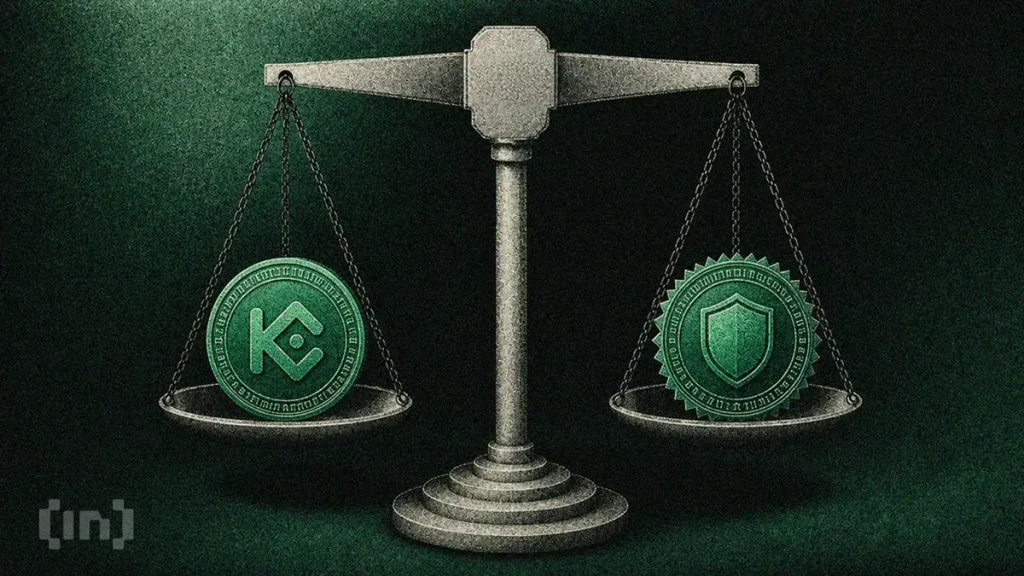
The appeal of cryptocurrency loans lies in their convenience. Traditional personal loans typically depend on factors like income, credit checks, and a fixed repayment schedule. In contrast, cryptocurrency-backed loans allow you to use assets you already own as collateral.
Users can raise funds without having to sell their assets, though a market downturn could put those assets at risk.
The cryptocurrency lending service launched by KuCoin this year appears promising for investors seeking flexibility. We have reviewed its lending rules, range of supported assets, reward mechanisms, and liquidation terms to understand its key advantages.
- Borrow Without Selling: How Flexible Is It?
Suppose you hold Bitcoin but need USDT for short-term trading. On the KuCoin platform, you can pledge your BTC as collateral to borrow USDT, then repay the loan later to release your assets. Throughout the loan period, you retain exposure to the price of Bitcoin.
The primary draw is flexibility. Flexible loans do not have fixed repayment dates; borrowers can repay the loan—either partially or in full—at any time, typically without incurring early repayment penalties.
Key features:
No fixed monthly repayment schedule.
Repayments (partial or full) can be made as needed.
Continued exposure to price volatility of the pledged assets.
A necessary trade-off: you must bear market risk. If the price of Bitcoin drops significantly, maintaining your loan eligibility could become challenging. Additionally, borrowing requires identity verification and a sufficient amount of eligible collateral.
The borrowed USDT remains in cryptocurrency form. Paying for everyday expenses may require converting the currency and withdrawing funds, which could incur additional costs.
- Asset Coverage: A Broader Range of Borrowing Options
KuCoin currently supports 13 cryptocurrencies for borrowing, including USDT, USDC, BTC, ETH, and SOL. The number of assets accepted as collateral has grown from an initial 5 to 47.
This selection extends beyond Bitcoin and Ethereum, accommodating a more diverse investment portfolio.
A notable addition is exposure to tokenized stocks: AAPLX, TSLAX, MSTRX, HOODX, and CRCLX. Eligible holders of tokenized stocks can borrow USDT without needing to sell their existing positions, subject to the exchange’s product rules.
Advantages Limitations
Wide range of collateral options, including altcoins and gold-backed tokens. Specific collateral weightings may reduce borrowing capacity.
Five new tokenized stock collateral options. Tokens linked to stocks introduce additional pricing risk.
Multiple assets available to support borrowing. Asset eligibility varies by jurisdiction.
Tokenized stocks track the performance of actual shares but do not confer the rights of common shareholders. Their prices may deviate from those of the underlying stocks, particularly outside of U.S. trading hours.
KuCoin has added five new stocks; however, their specific collateral weightings should be verified on the product page. Furthermore, KuCoin restricts the trading of “xStocks” in several countries, including the United States, the United Kingdom, and Portugal. Users should confirm their eligibility to trade these assets beforehand.
- “Hold-to-Earn” Rewards: Are They Worth It?
Eligible collateral assets can continue to accrue rewards if the “Hold-to-Earn” feature is enabled prior to taking out a loan. Any earned rewards are credited to the user’s Funding Account.
This can be beneficial for investors who already hold qualifying tokens. However, the actual financial gain warrants closer examination.
Consider the following example based on published Bitcoin reference rates:
Annualized yield (APY) on BTC rewards: 0.01%.
For a $10,000 investment in Bitcoin, this translates to approximately $1 in rewards per year.
Borrowing interest rates: Variable, updated on an hourly basis.
The calculation is straightforward: compare the cost of the loan against any potential earnings. Do not assume that the rewards will be sufficient to cover the loan interest.
Interest accrues hourly, and KuCoin’s terms allow for the compounding of unpaid interest on flexible loans. Consequently, a borrowing rate that appears attractive today could increase over the duration of the loan.
Additionally, the new tokenized stock collateral assets are not currently confirmed as eligible for “Hold-to-Earn” rewards. 4. Loan Management: Facilitating Multi-Asset Loans
Multiple collateral assets and loan liabilities are consolidated into a single account. Users can view their total debt, collateral, and Loan-to-Value (LTV) risk simultaneously, without needing to track individual loans separately.
For traders analyzing the market from their desks, web access is highly convenient. Through a browser, users can apply for loans, review terms, add collateral, make repayments, and redeem assets. KuCoin states that the functionality is identical across both the mobile app and the web interface.
This assessment is based on publicly available documentation; we have not personally executed any loans.
Key considerations include:
Unified Monitoring: Total borrowing exposure can be easily tracked within a single position.
Shared Risk: A sharp decline in the value of one collateral asset can weaken the entire position.
Liquidation: Exceeding applicable LTV thresholds may trigger the automatic sale of collateral and the incurrence of fees.
Collateral Rehypothecation: KuCoin’s terms permit the platform to stake, lend, or otherwise utilize pledged assets, which introduces additional platform-related risk.
KuCoin employs specific thresholds for Initial LTV, Warning LTV, and Liquidation LTV. The percentages published by the platform are illustrative examples rather than universal limits.
Users cannot withdraw collateral if doing so would cause them to fall out of compliance with borrowing requirements.
- Is KuCoin’s Crypto Lending Worth Using?
KuCoin’s crypto lending service is well-suited for experienced holders who are seeking temporary liquidity, understand the concept of Loan-to-Value (LTV) ratios, and are capable of closely monitoring their positions.
Pros | Areas for Improvement
Flexible borrowing and repayment options | Interest rates that fluctuate hourly
Broad range of supported collateral | Potential for low returns on investment
Unified position management | Shared liquidation risk
Accessible via both app and web | Asset-specific collateral weightings and borrowing limits
The primary strength of this product lies in its flexibility. Users can secure funds against a variety of existing holdings and manage their entire portfolio through a single interface.
The platform’s rewards features offer some additional value, though the actual financial gains may be modest. Tokenized stock collateral holds significant promise, though it is subject to geographical restrictions. Borrowing capacity is determined by the collateral weight assigned to each asset, its market price, and applicable borrowing limits.
Before taking out a loan, please review the real-time interest rates, collateral ratios, liquidation thresholds, and associated fees.
Cryptocurrency-backed lending remains a substantial market. According to data from Galaxy Research, the outstanding balance of cryptocurrency-backed loans stood at $56.2 billion as of the end of June 2026.

Comments